
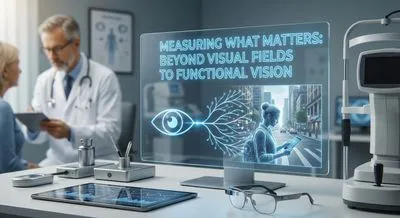
Measuring What Matters: Beyond Visual Fields to Functional Vision
Patient History and Questionnaires: Start by asking targeted questions every visit. Simple questions like “Do you have trouble reading or driving at...
Deep research and expert guides on maintaining your visual health.
Patient History and Questionnaires: Start by asking targeted questions every visit. Simple questions like “Do you have trouble reading or driving at...
Screen your peripheral vision from home — no downloads, no waiting rooms. Sign up for a free trial and test in under 5 minutes.
A driving simulation is a computer-based system that recreates the sights, sounds, and decisions of driving in a safe, controlled environment. It can range from a simple screen-based program to full-size mock cars with steering wheels, pedals, and immersive visual displays. Simulations let people practice driving skills and test reactions to hazards without risking real-world accidents. They are used by researchers, clinicians, and trainers to study how vision, attention, and motor skills affect road performance. Simulation can measure responses like reaction time, lane keeping, speed control, and the ability to spot pedestrians and signals. Because scenarios are repeatable, they provide consistent data for comparing performance before and after treatment or training. Simulators are especially useful for evaluating drivers who may have visual or cognitive impairments, and for developing rehabilitation plans. However, a simulated environment cannot perfectly mimic all real-world distractions, weather, and emotions, so results are interpreted alongside real-world tests. Despite limitations, simulation offers a practical and safe way to identify risks, guide interventions, and train safer driving habits. Its ability to create specific, controlled challenges makes it a powerful tool for protecting both individual drivers and public safety.