
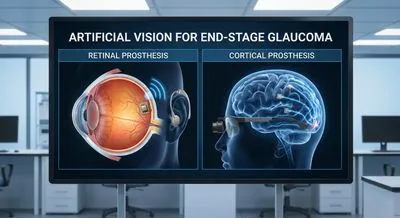
Artificial Vision for End-Stage Glaucoma: Retinal vs. Cortical Prostheses
In conditions like retinitis pigmentosa or macular degeneration, the photoreceptors die but RGCs and optic nerve remain intact () (). Retinal...
Deep research and expert guides on maintaining your visual health.
In conditions like retinitis pigmentosa or macular degeneration, the photoreceptors die but RGCs and optic nerve remain intact () (). Retinal...
Screen your peripheral vision from home — no downloads, no waiting rooms. Sign up for a free trial and test in under 5 minutes.
Argus II is a specific retinal implant system developed to give people with severe retinal degeneration a form of artificial vision by electrically stimulating the remaining retinal cells. The system uses a small array of electrodes that is implanted on the surface of the retina, together with glasses housing a camera and a processing unit that converts visual information into electrical pulses. When worn and activated, the device produces patterns of light perception that recipients can learn to interpret as edges, motion, or basic shapes, which can help with navigation and object detection. The experience is not like natural sight; it provides low-resolution, high-contrast signals that require training and rehabilitation to be useful in daily life. Argus II was one of the first retinal prosthesis systems to be used widely in clinical settings and to receive regulatory approvals, which helped establish standards for safety and effectiveness in the field. Users report benefits such as improved orientation, easier mobility, and greater independence, though outcomes vary across individuals. Surgical implantation carries risks, and the system has limitations in image detail, update speed, and long-term electrode performance. Despite these limits, Argus II represented an important milestone that encouraged further research and development in devices aiming to restore vision. Ongoing work builds on lessons from Argus II to improve resolution, biocompatibility, and the range of people who might benefit.