
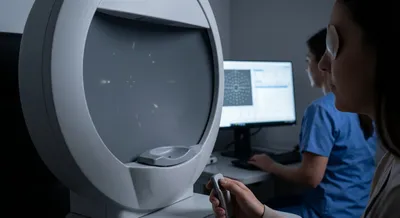
What Is a 24-2 Visual Field Test
The name “24-2” comes from the visual field area and pattern spacing it covers. The “24” means the test covers the central 24 degrees of your vision...
Deep research and expert guides on maintaining your visual health.
The name “24-2” comes from the visual field area and pattern spacing it covers. The “24” means the test covers the central 24 degrees of your vision...
Our visual field test is inspired by the perimetry methods eye care professionals use. Check for blind spots and track changes over time.
Test Your VisionVisual field interpretation is the process of reading and making sense of the results from perimetry tests that map how well you see across your field of view. It involves looking at numerical summaries, gray-scale maps, and specialized plots that show where vision is normal, reduced, or absent. Key summary numbers include measures of overall sensitivity and irregularity, which help clinicians determine whether loss is generalized or focused in certain areas. Patterns of loss can point to different causes: for example, a wedge-shaped defect may suggest glaucoma, while a loss that respects the vertical midline could indicate a brain-related problem. Interpreters also check reliability indicators, because false positives, missed responses, and poor fixation can make results misleading. Comparing current fields with previous tests is important to see if a condition is stable, improving, or worsening over time. Doctors combine the field data with exam findings and imaging, since the same visual defect can come from problems in the eye, optic nerve, or brain. Understanding the size, depth, and location of a defect helps guide treatment choices, such as adjusting therapy for glaucoma or ordering further imaging for suspected neurological disease. Because visual field testing can vary day-to-day, repeated testing and looking for consistent trends offers the most reliable information. Good interpretation requires experience and attention to detail, but it is a powerful tool for diagnosing problems and tracking changes that affect vision and quality of life.