
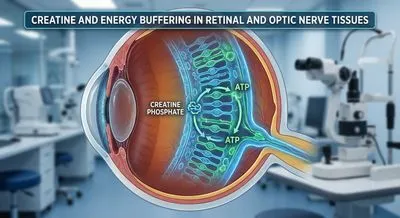
Creatine and Energy Buffering in Retinal and Optic Nerve Tissues
Importantly, this system exists not only in muscle but in nerve cells. Neurons (including RGCs) express CK isoforms that enable them to use creatine....
Deep research and expert guides on maintaining your visual health.
Importantly, this system exists not only in muscle but in nerve cells. Neurons (including RGCs) express CK isoforms that enable them to use creatine....
Track peripheral vision changes between eye doctor visits. Start your free trial and get results in under 5 minutes.
Photcreatine refers to a creatine molecule that carries a high-energy phosphate group, more commonly known as phosphocreatine in biology. This molecule acts as a quick energy reserve inside cells, storing chemical energy that can be released fast when a cell needs ATP. When energy demand suddenly rises, an enzyme called creatine kinase transfers the phosphate group from photcreatine to ADP, rapidly rebuilding ATP for immediate use. That fast buffering system helps cells with fluctuating energy needs work smoothly without depending solely on slower processes like making new ATP from food. Tissues that fire quickly or often — for example muscle, brain cells, and parts of the eye — rely on this system to handle short bursts of high energy demand. In the retina and optic nerve, where cells must process light signals continually, this energy buffering supports proper signaling and helps protect against brief energy shortages. Because of its central role in cellular energy, variations in creatine or its storage form can influence how well tissues cope with stress or disease. Some people take creatine supplements to increase tissue stores and possibly improve energy buffering, but effects vary by tissue type and individual health. Researchers also study the molecule to understand diseases linked to energy failure and to explore whether boosting this system could be protective.