
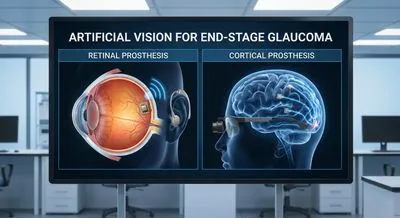
Artificial Vision for End-Stage Glaucoma: Retinal vs. Cortical Prostheses
In conditions like retinitis pigmentosa or macular degeneration, the photoreceptors die but RGCs and optic nerve remain intact () (). Retinal...
Deep research and expert guides on maintaining your visual health.
In conditions like retinitis pigmentosa or macular degeneration, the photoreceptors die but RGCs and optic nerve remain intact () (). Retinal...
Screen your peripheral vision from home — no downloads, no waiting rooms. Sign up for a free trial and test in under 5 minutes.
Artificial vision refers to technologies that create or restore a sense of sight by using machines to produce visual information for a person who is blind or severely visually impaired. It usually combines a camera or sensor, a processing unit, and an interface that delivers signals to the eye or directly to the brain. The systems can work by stimulating surviving cells in the eye or by bypassing the eye entirely and stimulating brain tissue, depending on the cause of vision loss. Artificial vision does not reproduce natural sight yet; instead it often provides simplified visual cues such as points of light, contrast, or motion that the user learns to interpret. These devices require training and adaptation, because the brain must learn how to make sense of the new signals. Developers measure success not only by technical resolution but by how well users can navigate, recognize objects, and perform daily activities. Artificial vision matters because it offers a way to restore useful sight to people who currently have few options, improving independence and quality of life. It also pushes forward understanding of how the visual system processes information and how machines and biology can work together. There are still limitations and challenges, including surgical risks, device durability, power and data transfer, and the need for personalized tuning. Ongoing research aims to improve resolution, reduce invasiveness, and make systems more affordable and widely available.