
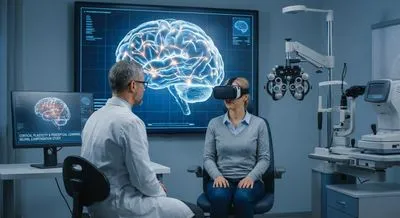
Cortical Plasticity and Perceptual Learning: Can the Brain Compensate for Optic Nerve Damage?
Interestingly, many glaucoma patients have little awareness of their blind spots. This perceptual filling-in – where the brain “fills” missing...
Deep research and expert guides on maintaining your visual health.
Interestingly, many glaucoma patients have little awareness of their blind spots. This perceptual filling-in – where the brain “fills” missing...
Our visual field test is inspired by the perimetry methods eye care professionals use. Check for blind spots and track changes over time.
Test Your VisionPerceptual learning is the process by which repeated experience or practice causes lasting improvement in the way you notice and interpret sensory information. It usually refers to changes in how the brain processes input from senses like sight, hearing, or touch, so basic tasks become easier or more precise. For example, a person who practices spotting small differences in shapes or shades can learn to see those differences faster and more accurately. These improvements come from changes in the brain’s networks rather than changes in the eye or ear themselves. Perceptual learning matters because it shows that adult brains can adapt and get better at tasks with the right kind of practice. This kind of learning is used in rehabilitation, education, and skill training because it can sharpen real-world abilities like reading, object recognition, or identifying sounds. It also highlights why training needs to be specific and repeated: gains are often strongest for the exact stimuli and conditions that were practiced. Researchers study perceptual learning to design better therapies for people with sensory deficits and to understand how plastic the adult brain really is. While results can be powerful, transfer to very different tasks is limited, so training programs are carefully tailored to the goals they aim to achieve.