
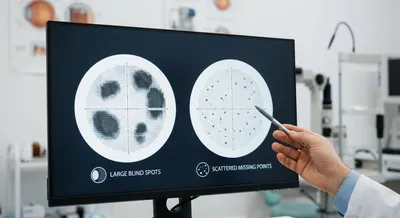
Patterns of Vision Loss in Glaucoma: Large Blind Spots Versus Scattered Missing Points
Diffuse or scattered defects (small-point losses) – Other patients show many isolated points of sensitivity loss scattered across the field, often...
Deep research and expert guides on maintaining your visual health.
Diffuse or scattered defects (small-point losses) – Other patients show many isolated points of sensitivity loss scattered across the field, often...
Screen your peripheral vision from home — no downloads, no waiting rooms. Sign up for a free trial and test in under 5 minutes.
Visual impairment means having a reduced ability to see that cannot be fully corrected with regular glasses, contact lenses or standard medical treatment. It covers a wide range, from mild difficulties in reading small print to complete blindness, and can be temporary or permanent. Causes include eye diseases, injuries, problems present at birth, and conditions related to aging or other health issues. Clinicians measure vision with tests that check sharpness, field of view, and how well the eyes work together to understand the extent of loss. Because sight plays a central role in how most people navigate the world, even small losses can change daily routines, work, and relationships. Living with visual impairment often requires adaptations like magnifiers, specialized lighting, white canes, guide animals, and screen-reading or voice-access technology. Early diagnosis, medical care when possible, and rehabilitation services that teach skills for safe mobility and independent living greatly improve quality of life. Accessibility in buildings, public transport, digital services and workplaces helps people with vision loss participate fully in society. Social support, education about accommodations, and policies that reduce barriers matter as much as medical care in preventing isolation and enabling opportunity. Understanding visual impairment promotes empathy, better design, and fairer access so people with sight loss can live safely, work, learn, and contribute like everyone else.