
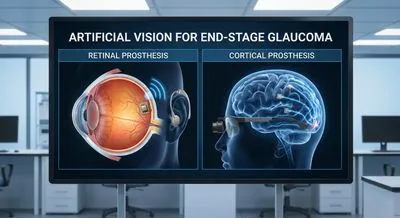
Artificial Vision for End-Stage Glaucoma: Retinal vs. Cortical Prostheses
In conditions like retinitis pigmentosa or macular degeneration, the photoreceptors die but RGCs and optic nerve remain intact () (). Retinal...
Deep research and expert guides on maintaining your visual health.
In conditions like retinitis pigmentosa or macular degeneration, the photoreceptors die but RGCs and optic nerve remain intact () (). Retinal...
Our visual field test is inspired by the perimetry methods eye care professionals use. Check for blind spots and track changes over time.
Test Your VisionA bionic eye is a broad, popular term for a device that helps restore some visual function by mimicking key roles of a healthy eye through electronic means. It usually combines an external camera or sensor with an implanted component that stimulates the nervous system, allowing light and pattern information to be perceived even when the eye itself is damaged. The experience provided by a bionic eye is different from normal sight; users often see points of light or basic outlines that require practice to interpret. These devices can be life-changing for people who have lost sight from diseases that leave other parts of the visual pathway intact, offering improved independence and safety. Surgery, rehabilitation, and ongoing adjustments are part of the process, and outcomes depend on the cause of blindness and the individual's brain plasticity. A bionic eye is important because it moves beyond assistive tools like canes or guide dogs by restoring sensory input rather than simply compensating for loss. Technical challenges include limited resolution, electrode interface stability, and power supply, but progress is continuous. Public interest in the concept has also spurred investment and innovation across medicine, robotics, and computing. Over time, advances in materials, signal processing, and neural interfaces aim to make these systems more effective and accessible.