
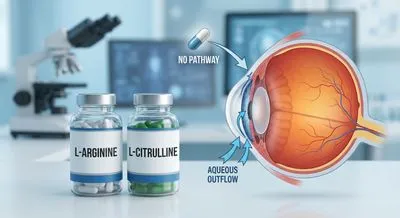
Nitric Oxide Pathway Supplements (L-Arginine, L-Citrulline) and Aqueous Outflow
The body also has a backup route to make NO from dietary nitrates (the “nitrate–nitrite–NO pathway”). Normally, under conditions like low oxygen or...
Deep research and expert guides on maintaining your visual health.
The body also has a backup route to make NO from dietary nitrates (the “nitrate–nitrite–NO pathway”). Normally, under conditions like low oxygen or...
Our visual field test is inspired by the perimetry methods eye care professionals use. Check for blind spots and track changes over time.
Test Your VisionDoppler ultrasound is a medical imaging technique that uses sound waves to measure how blood moves through vessels. It works by sending high-frequency sound into the body and detecting changes in the sound when it bounces off moving blood cells; those changes tell the machine the speed and direction of blood flow. The scan often displays color maps or waveforms so doctors can see whether flow is normal, slowed, reversed, or blocked. It is noninvasive, painless, and does not use radiation, so it is safe for repeated use and for pregnant people. Clinicians use it to look for blood clots, narrowed arteries, problems with heart valves, and to monitor blood flow in organs and developing babies. The test provides functional information that a regular structural ultrasound cannot, making it very useful for diagnosing and guiding treatment of vascular conditions. However, results can depend on the skill of the operator and certain body areas are harder to image because of bone or air. Overall, Doppler ultrasound is a practical, widely available tool that helps doctors assess circulation quickly and safely.