

The Glaucoma Energy Crisis: How Pyruvate Rescues Failing Eyes (And Why Your Fitness Level Matters)
Even if you load up on pyruvate, an inactive body won’t convert it to extra ATP unless it’s needed. Instead, the surplus pyruvate enters normal...
Deep research and expert guides on maintaining your visual health.
Even if you load up on pyruvate, an inactive body won’t convert it to extra ATP unless it’s needed. Instead, the surplus pyruvate enters normal...
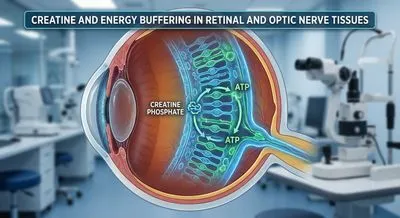
Importantly, this system exists not only in muscle but in nerve cells. Neurons (including RGCs) express CK isoforms that enable them to use creatine....
Our visual field test is inspired by the perimetry methods eye care professionals use. Check for blind spots and track changes over time.
Test Your VisionEnergy metabolism is the set of chemical reactions inside cells that convert the food we eat into usable energy. Cells break down carbohydrates, fats, and proteins into smaller molecules and then use those pieces to make a molecule called ATP, which powers nearly every action in the body. Mitochondria, often called the cell’s power plants, play a central role in this process by using oxygen to extract lots of energy from food. There are simpler, faster paths that work without oxygen too, but they produce less ATP and can lead to buildup of byproducts like lactate. Energy metabolism is flexible: depending on activity level, diet, and oxygen supply, the body shifts among different fuels and pathways. That flexibility keeps muscles working during exercise, helps the brain run smoothly, and supports organs at rest. When energy metabolism is disrupted, people feel fatigued, have trouble concentrating, or may develop medical conditions like diabetes or metabolic syndrome. Scientists measure aspects of energy metabolism to understand health, guide treatments, and improve athletic performance. Simple lifestyle choices such as balanced eating, regular physical activity, and enough sleep help keep these energy systems working well. Understanding energy metabolism makes it easier to see why food, breathing, and movement matter for everyday energy and long-term health.