
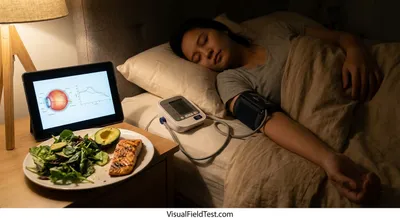
Low-Carb Diets and Nocturnal Blood Pressure Dips: Ocular Perfusion Risks and Benefits
Research has shown that excessive night-time hypotension is associated with glaucomatous damage. In fact, Hayreh and colleagues found that night-time...
Deep research and expert guides on maintaining your visual health.
Research has shown that excessive night-time hypotension is associated with glaucomatous damage. In fact, Hayreh and colleagues found that night-time...
Track peripheral vision changes between eye doctor visits. Start your free trial and get results in under 5 minutes.
Ambulatory monitoring means using a small, portable device to record a person’s body measurements while they go about normal daily life. Instead of taking a single reading in a clinic, the device collects data over many hours or days—often at regular intervals or continuously—to show how things change during sleep, work, exercise, and rest. This approach is commonly used for blood pressure, heart rhythm, glucose levels, oxygen saturation, and sleep breathing. Because it captures measurements in real-world settings, ambulatory monitoring reveals patterns that a single clinic checkup can miss, such as spikes, dips, or predictable daily rhythms. It can uncover conditions like elevated readings only in medical settings or abnormal nighttime changes that affect health risk. Doctors use the results to make better decisions about diagnosis, treatment plans, and whether a medication is working. The devices are generally easy to wear but can cause mild inconvenience or brief discomfort, and they must be set up and interpreted correctly by trained staff. While they provide richer information than office tests, the data also need careful review so doctors can separate meaningful signals from normal variation. Overall, ambulatory monitoring gives a more complete, accurate picture of a person’s health by measuring how their body behaves in everyday life.