
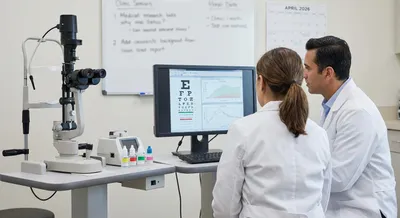
Washout and Rescue Protocols in April 2026 IOP-Lowering Studies
Beta-blockers (e.g. timolol): These are typically washed out by stopping the drop for 4 weeks. Research showed that a 2-week break is usually too...
Deep research and expert guides on maintaining your visual health.
Beta-blockers (e.g. timolol): These are typically washed out by stopping the drop for 4 weeks. Research showed that a 2-week break is usually too...
Our visual field test is inspired by the perimetry methods eye care professionals use. Check for blind spots and track changes over time.
Test Your VisionEfficacy estimates are numbers that describe how well a treatment, drug, or intervention works in a study. They summarize the change that the intervention produced compared with no treatment or a comparison treatment. Usually they come from experiments or clinical trials and are calculated from the study data. Common forms include percentages, differences in averages, or rates of improvement or decline. An estimate is just a best guess based on the data, not a perfect fact, and it can change as more evidence appears. Efficacy estimates matter because they help patients, doctors, and regulators decide whether a new approach is worth using. They also guide researchers and funders about where to focus future work and whether an effect is clinically meaningful. When you look at an efficacy estimate pay attention to the size of the effect and the uncertainty around it, often shown as a confidence range or margin of error. Small studies or biased designs can produce unreliable estimates, so stronger trials and larger sample sizes usually give more trustworthy results. Finally, real-world results can differ from initial estimates, so ongoing monitoring and additional studies are important to confirm how well something truly works for different people.