Visual Field Test Logo

Fmri

Grundig forskning og ekspertguider for å opprettholde synshelsen din.

कॉर्टिकल प्लास्टिसिटी और अवधारणात्मक शिक्षण: क्या मस्तिष्क ऑप्टिक तंत्रिका क्षति की क्षतिपूर्ति कर सकता है?

कॉर्टिकल प्लास्टिसिटी और अवधारणात्मक शिक्षण: क्या मस्तिष्क ऑप्टिक तंत्रिका क्षति की क्षतिपूर्ति कर सकता है?

दिलचस्प बात यह है कि कई ग्लूकोमा रोगियों को अपने अंधे धब्बों के बारे में बहुत कम जानकारी होती है। इस अवधारणात्मक भरने-में (perceptual filling-in) –...

Φλοιώδης Πλαστικότητα και Αντιληπτική Μάθηση: Μπορεί ο Εγκέφαλος να Αντισταθμίσει τη Βλάβη του Οπτικού Νεύρου;

Φλοιώδης Πλαστικότητα και Αντιληπτική Μάθηση: Μπορεί ο Εγκέφαλος να Αντισταθμίσει τη Βλάβη του Οπτικού Νεύρου;

Είναι ενδιαφέρον ότι πολλοί ασθενείς με γλαύκωμα έχουν ελάχιστη επίγνωση των τυφλών κηλίδων τους. Αυτή η αντιληπτική συμπλήρωση – όπου ο εγκέφαλος...

ความยืดหยุ่นของเปลือกสมองและการเรียนรู้การรับรู้: สมองสามารถชดเชยความเสียหายของเส้นประสาทตาได้หรือไม่?

ความยืดหยุ่นของเปลือกสมองและการเรียนรู้การรับรู้: สมองสามารถชดเชยความเสียหายของเส้นประสาทตาได้หรือไม่?

ที่น่าสนใจคือ ผู้ป่วยต้อหินจำนวนมากแทบไม่รู้ตัวถึงจุดบอดของตนเอง ปรากฏการณ์ perceptual filling-in นี้ – ที่สมอง “เติมเต็ม” ข้อมูลส่วนรอบนอกที่หายไป –...

皮質可塑性と知覚学習:脳は視神経損傷を代償できるか?

皮質可塑性と知覚学習:脳は視神経損傷を代償できるか?

興味深いことに、多くの緑内障患者は自身の暗点にほとんど気づいていません。この知覚的補完(脳が欠落した周辺情報を「埋める」こと)は、神経の代償を反映していると考えられています。例えば、ある脳画像研究では、緑内障患者(重度の視野喪失がある場合でも)は、脳が欠陥領域を効果的にマスクまたは「補完」するため、...

Klar til å sjekke synet ditt?

Start din gratis synsfelttest på mindre enn 5 minutter.

Start test nå

fMRI

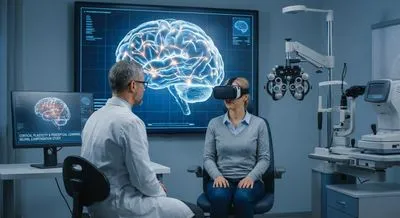
Functional magnetic resonance imaging, commonly called fMRI, is a brain imaging method that measures changes in blood flow to infer which parts of the brain are active. It uses a strong magnet and radio waves to create detailed pictures of the brain and detects a signal called the BOLD response, which stands for blood-oxygen-level-dependent contrast. When a brain region becomes more active, it consumes more oxygen and nearby blood flow increases, and fMRI picks up that change. The technique is noninvasive, meaning it doesn’t require injections or surgery, and it can map activity across the whole brain at once. Researchers and clinicians use fMRI to study how different brain areas work together, to track changes over time, and to see how the brain adapts after injury or disease. It matters because it gives a window into brain function that helps explain behavior, perception, and recovery processes. However, fMRI measures blood flow indirectly rather than the electrical firing of neurons, so its signals are slower and less precise in time than the brain’s actual activity. It also can be expensive, sensitive to motion, and not suitable for people with certain metal implants. Despite these limitations, fMRI has become a powerful tool for understanding brain organization, guiding research, and sometimes aiding clinical decisions about disorders that affect thinking and sensation.