
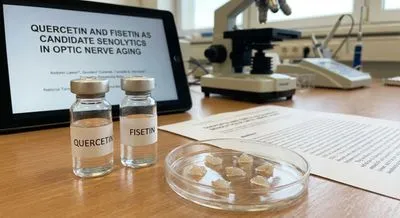
Quercetin dan Fisetin sebagai Kandidat Senolitik dalam Penuaan Saraf Optik
Penuaan, Senesens, dan Glaukoma Glaukoma adalah penyebab utama kebutaan dan risikonya meningkat seiring bertambahnya usia. Pada mata yang menua, sel-s...
Dziļi pētījumi un ekspertu rokasgrāmatas par jūsu redzes veselības uzturēšanu.
Penuaan, Senesens, dan Glaukoma Glaukoma adalah penyebab utama kebutaan dan risikonya meningkat seiring bertambahnya usia. Pada mata yang menua, sel-s...
Envelhecimento, Senescência e Glaucoma O glaucoma é uma das principais causas de cegueira e seu risco aumenta com a idade. Em olhos envelhecidos, as c...
Старение, Сенесценция и Глаукома Глаукома является одной из ведущих причин слепоты, и ее риск возрастает с возрастом. В стареющих глазах клетки могут...
Åldrande, senescens och glaukom Glaukom är en ledande orsak till blindhet och dess risk ökar med åldern. I åldrade ögon kan celler hamna i ett senesce...
उम्र बढ़ना, सेनेसेंस और ग्लूकोमा ग्लूकोमा अंधत्व का एक प्रमुख कारण है और उम्र के साथ इसका जोखिम बढ़ता है। वृद्ध आँखों में, कोशिकाएँ एक सेनेसेंट अवस्था...
การชราภาพ, ภาวะเซลล์ชรา และโรคต้อหิน โรคต้อหินเป็นสาเหตุสำคัญของการตาบอดและความเสี่ยงเพิ่มขึ้นตามอายุ ในดวงตาที่สูงวัย เซลล์สามารถเข้าสู่ภาวะเซลล์ชรา...
衰老、细胞衰老与青光眼 青光眼是导致失明的主要原因之一,其风险随年龄增长而升高。在衰老的眼睛中,细胞可能进入衰老状态——它们停止分裂但仍存活——并释放有害信号,即衰老相关分泌表型 (SASP)。眼部衰老细胞会加剧疾病。例如,衰老的小梁网细胞(眼部前方的滤器)会变得僵硬和堵塞,从而提高眼压 (pmc....
Îmbătrânire, Senescență și Glaucom Glaucomul este o cauză principală de orbire, iar riscul său crește odată cu vârsta. În ochii îmbătrâniți, celulele...
老化、細胞老化、そして緑内障 緑内障は失明の主要な原因であり、そのリスクは年齢とともに上昇します。老化した目では、細胞は老化状態(分裂を停止するが生きて残る状態)に入り、老化関連分泌表現型 (SASP) と呼ばれる有害なシグナルを放出することがあります。目の老化細胞は病状を悪化させる可能性があります...
Envejecimiento, Senescencia y Glaucoma El glaucoma es una de las principales causas de ceguera y su riesgo aumenta con la edad. En los ojos envejecido...
Aging, Senescence, and Glaucoma Glaucoma is a leading cause of blindness and its risk rises with age. In aged eyes, cells can enter a senescent state...
Sāciet bezmaksas redzes lauka testu mazāk nekā 5 minūtēs.
Sākt testu tagadSASP stands for senescence-associated secretory phenotype and describes the mix of substances released by senescent cells. These secretions include inflammatory molecules, growth factors, enzymes that break down tissue, and other chemical messengers that affect neighboring cells. In the short term, the secreted signals can help attract immune cells to clear damaged cells and support tissue repair. But when senescent cells persist, this secretory profile becomes chronic and fuels low-grade inflammation in nearby tissue. Chronic SASP activity can disrupt normal cell behavior, promote fibrosis, impair regeneration, and in some cases encourage tumor growth. Different types of senescent cells produce different versions of this secretory pattern, so its effects vary by tissue and context. Because it plays a central role in how senescent cells influence their environment, SASP is a major focus for researchers developing therapies to reduce age-related damage. Scientists are exploring drugs and natural compounds that either remove the cells producing the signals or dampen the harmful secretions, and measuring elements of this mix can serve as markers for tissue health or treatment response.