

Apport en protéines, homocystéine et risque de glaucome pseudoexfoliatif
Des études de régimes contrôlés chez des volontaires sains montrent exactement cette relation : un régime hyperprotéiné de 8 jours (environ 21 % de...
Recherches approfondies et guides d'experts pour maintenir votre santé visuelle.
Des études de régimes contrôlés chez des volontaires sains montrent exactement cette relation : un régime hyperprotéiné de 8 jours (environ 21 % de...
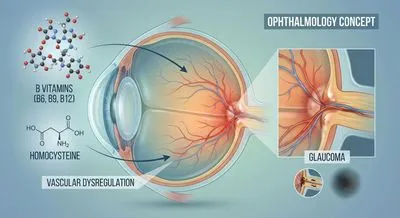
La recherche suggère que les dommages vasculaires liés à l'homocystéine sont pertinents pour le glaucome. Par exemple, les modèles animaux de...
Les taches aveugles se développent souvent progressivement sans symptômes. Commencez un essai gratuit et effectuez un test rapide du champ visuel pour détecter les changements tôt.
Découvrez-le maintenantL'homocystéine est un acide aminé naturellement produit par le corps lors du métabolisme de la méthionine, un autre acide aminé que l'on obtient via l'alimentation. Ce n'est pas un constituant des protéines mais un intermédiaire chimique qui doit être transformé pour rester à des niveaux sains. Deux voies principales permettent sa conversion : la reméthylation pour reformer la méthionine et la transsulfuration pour former la cystéine. Ces réactions nécessitent des vitamines comme la B6, la B12 et l'acide folique comme cofacteurs. Lorsque l'homocystéine s'accumule dans le sang, on parle d'hyperhomocystéinémie, une situation associée à un risque accru de troubles vasculaires comme l'athérosclérose et la thrombose. Des niveaux élevés peuvent aussi être liés à des problèmes neurologiques, des troubles cognitifs et à certaines complications pendant la grossesse. Plusieurs facteurs influencent sa concentration : l'alimentation, la génétique (par exemple des variations du gène MTHFR), la fonction rénale, le tabagisme et certains médicaments. On mesure l'homocystéine par une prise de sang pour évaluer le risque cardiovasculaire ou explorer des symptômes neurologiques inexpliqués. Dans bien des cas, des apports suffisants en vitamines B et des changements alimentaires peuvent faire baisser les niveaux, mais l'effet sur le risque clinique dépend du contexte individuel. Comprendre et surveiller l'homocystéine aide donc à mieux évaluer la santé vasculaire et neurologique et à adapter les mesures préventives ou les traitements.