
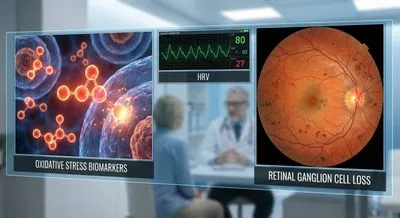
Biomarqueurs du stress oxydatif, VFC et perte de cellules ganglionnaires de la rétine
Dans cet article, nous expliquons ce que sont les marqueurs de stress oxydatif comme les F2-isoprostanes, le malondialdéhyde (MDA) et la...
Recherches approfondies et guides d'experts pour maintenir votre santé visuelle.
Dans cet article, nous expliquons ce que sont les marqueurs de stress oxydatif comme les F2-isoprostanes, le malondialdéhyde (MDA) et la...
Les taches aveugles se développent souvent progressivement sans symptômes. Commencez un essai gratuit et effectuez un test rapide du champ visuel pour détecter les changements tôt.
Découvrez-le maintenantLes F2-isoprostanes sont des molécules produites lorsque des radicaux libres attaquent les lipides des membranes cellulaires, en particulier l'acide arachidonique. Elles se forment de façon non enzymatique par peroxydation des lipides, ce qui en fait de bons indicateurs du stress oxydatif dans l'organisme. Le stress oxydatif correspond à un déséquilibre entre des composés réactifs et la capacité de l'organisme à les neutraliser, et il peut endommager les cellules, les protéines et l'ADN. Mesurer les F2-isoprostanes dans le sang, l'urine ou d'autres liquides corporels donne une estimation fiable du niveau d'oxydation en cours. Ces mesures sont considérées comme plus stables et plus spécifiques que beaucoup d'autres marqueurs d'oxydation, d'où leur utilité en recherche et en clinique. Des taux élevés de F2-isoprostanes sont associés à des maladies liées au vieillissement, aux problèmes cardiovasculaires, au diabète, à des troubles neurodégénératifs et à certaines atteintes oculaires. En pratique, elles servent à évaluer le risque, suivre l'évolution d'une maladie et mesurer l'effet d'un traitement antioxydant. Leur détection exige des méthodes précises en laboratoire, comme la chromatographie couplée à la spectrométrie de masse, car d'autres techniques peuvent être moins fiables. On observe une augmentation de ces molécules chez les fumeurs, les personnes exposées à la pollution, ou celles ayant une inflammation chronique ou un excès de poids. Il faut toutefois garder à l'esprit que des valeurs élevées indiquent un stress oxydatif mais ne suffisent pas à poser un diagnostic unique ; elles doivent être interprétées avec d'autres éléments cliniques. En résumé, les F2-isoprostanes sont un indicateur utile et scientifiquement solide du stress oxydatif et aident à comprendre et à surveiller les dommages liés aux réactions oxydantes dans le corps.