
Can Restoring Ocular Perfusion Restore Vision? OCT-A and Vascular Therapies
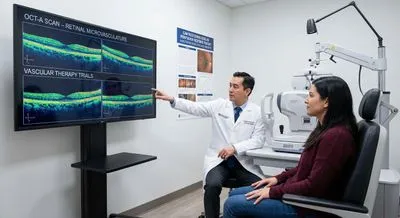
OCT-Angiography (OCT-A) captures images of blood flow by detecting moving red blood cells in the eye’s capillaries. Two key metrics are often...
Deep research and expert guides on maintaining your visual health.
OCT-Angiography (OCT-A) captures images of blood flow by detecting moving red blood cells in the eye’s capillaries. Two key metrics are often...
Screen your peripheral vision from home — no downloads, no waiting rooms. Sign up for a free trial and test in under 5 minutes.
Vessel density refers to the proportion of a scanned area that is occupied by blood vessels when viewed with imaging tools. In eye imaging, it is often calculated from angiography scans as a percentage or fraction of the region filled by vessels. Higher vessel density usually means more capillaries and better tissue perfusion, while lower density can indicate loss of vessels or poor blood supply. Measuring vessel density helps doctors identify areas of ischemia, vessel dropout, or abnormal vessel growth. It is used to track progression of diseases such as diabetic retinopathy, macular degeneration, and ischemic optic nerve conditions. Because vessel density is a simplified summary of complex blood networks, it does not tell you how fast blood is flowing or how well oxygen is being delivered. The measurement can be affected by scan quality, patient movement, the size of the scan area, and how images are processed. For meaningful results, clinicians compare vessel density over time in the same patient or against age-matched reference values. As a quantitative marker, it is valuable for deciding when to treat, assessing treatment effects, and for research into eye health and disease.