
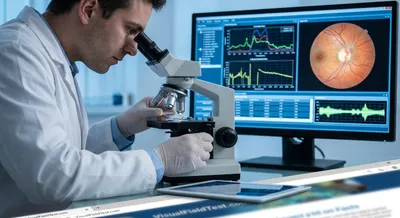
Kann der Sehnerv geschützt werden? Die neue Ära der Neuroprotektion in der Glaukomforschung
In der Netzhaut des Auges arbeiten spezielle Nervenzellen, sogenannte retinale Ganglienzellen (RGCs), wie Telefonleitungen, die visuelle Signale vom...
Tiefgehende Forschung und Expertenratgeber zur Erhaltung Ihrer Sehgesundheit.
In der Netzhaut des Auges arbeiten spezielle Nervenzellen, sogenannte retinale Ganglienzellen (RGCs), wie Telefonleitungen, die visuelle Signale vom...
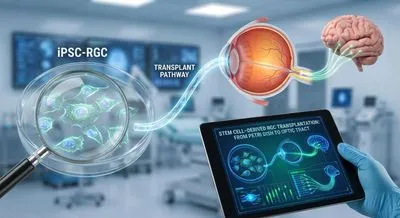
RGCs sind kein einheitlicher Zelltyp. Es gibt Dutzende von RGC-Subtypen (z.B. bewegungsempfindliche richtungsselektive Zellen, On/Off-Zentrum-Zellen,...
Verfolgen Sie Veränderungen des peripheren Sehens zwischen den Augenarztbesuchen. Starten Sie Ihre kostenlose Testversion und erhalten Sie Ergebnisse in unter 5 Minuten.
Neuroregeneration beschreibt die Fähigkeit des Nervensystems, verlorene oder beschädigte Nervenzellen, deren Fortsätze und Verbindungen zu erneuern oder zu ersetzen. Das schließt mehrere Prozesse ein: das Wachstum neuer Nervenzellen, das Wiederherstellen von Axonen und Dendriten, die Reparatur von Myelinscheiden und die Bildung funktionaler Verbindungen. Im peripheren Nervensystem (zum Beispiel in Armen und Beinen) findet diese Reparatur oft relativ gut statt, während das zentrale Nervensystem im Gehirn und Rückenmark nur sehr begrenzt regeneriert. Gründe dafür sind eine hemmende Umgebung nach Verletzungen, Narbenbildung und das Fehlen bestimmter Wachstumsfaktoren im Erwachsenenalter. Neuroregeneration ist wichtig, weil sie die Grundlage für die Erholung nach Schlaganfall, Rückenmarksverletzungen, Traumata und neurodegenerativen Erkrankungen bilden kann. Forschungsmethoden reichen von Rehabilitation und physikalischer Therapie über Medikamente, die Wachstum unterstützen, bis hin zu Zelltherapien und genbasierten Ansätzen. Auch Biomaterialien, die als Brücken dienen, und gezielte Stimulation des Nervensystems werden erprobt, um den Regenerationsprozess zu fördern. Ein Ziel ist nicht nur das reine Nachwachsen, sondern dass neue oder reparierte Verbindungen auch korrekt funktionieren und zu spürbaren Verbesserungen führen. Herausforderungen sind das Verhindern von Entzündungen, das Steuern von Zellwachstum und die Sicherheit neuer Therapien gegenüber Nebenwirkungen wie Fehlverknüpfungen oder Tumorbildung. Trotz dieser Hürden bietet die Neuroregeneration große Hoffnung für Patienten, weil Fortschritte langfristig zu besseren Behandlungsoptionen und mehr Selbstständigkeit führen können.