
Penglihatan Buatan untuk Glaucoma Stadium Akhir: Prostesis Retina vs. Kortikal
Penglihatan Buatan untuk Glaucoma Stadium Akhir: Prostesis Retina vs. Kortikal Glaucoma stadium lanjut merusak saraf optik dan sel ganglion retina (RG...
بحث عميق وأدلة خبراء حول الحفاظ على صحتك البصرية.
Penglihatan Buatan untuk Glaucoma Stadium Akhir: Prostesis Retina vs. Kortikal Glaucoma stadium lanjut merusak saraf optik dan sel ganglion retina (RG...
İleri Evre Glokomda Yapay Görme: Retinal ve Kortikal Protezler İleri glokom optik sinir ve retinal ganglion hücrelerini (RGH'ler) yok ederek hastaları...
Sztuczne widzenie w zaawansowanej jaskrze: Protezy siatkówkowe a korowe Zaawansowana jaskra niszczy nerw wzrokowy i komórki zwojowe siatkówki (RGC), p...
Umělé vidění pro pokročilé stadium glaukomu: Sítnicové vs. kortikální protézy Pokročilý glaukom ničí zrakový nerv a retinální gangliové buňky (RGC), c...
Visão Artificial para Glaucoma em Estágio Avançado: Próteses Retinianas vs. Corticais O glaucoma avançado destrói o nervo óptico e as células ganglion...
Dirbtinė rega esant galutinės stadijos glaukomai: tinklainės ir žievės protezai Išsivysčiusi glaukoma sunaikina regos nervą ir tinklainės ganglijų ląs...
Искусственное зрение при терминальной глаукоме: ретинальные против кортикальных протезов Прогрессирующая глаукома разрушает зрительный нерв и ганглиоз...
晚期青光眼的仿生视觉:视网膜假体与皮层假体比较 晚期青光眼会杀死视神经和视网膜神经节细胞(RGCs),导致患者失明。仿生视觉(视觉假体)旨在绕过此类损伤。大多数现有假体针对视网膜或视神经,但在晚期青光眼患者中,这些通路已经消失。因此,研究人员正在探索直接刺激视觉皮层(大脑)的植入物。本文比较了用于青...
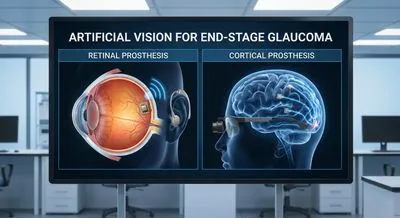
Artificial Vision for End-Stage Glaucoma: Retinal vs. Cortical Prostheses Advanced glaucoma kills the optic nerve and retinal ganglion cells (RGCs), l...
ORION is the name given to a type of cortical visual prosthesis designed to restore some degree of sight by directly stimulating the visual part of the brain. Instead of relying on a working eye or retina, the system captures images with a camera, processes those images, and sends electrical signals to a small array of electrodes placed on the visual cortex. When the brain receives these pulses, people perceive small flashes or points of light called phosphenes, and with training those flashes can be interpreted as basic shapes, movement, or contrast. The goal is not to recreate normal vision but to provide useful visual cues that help with orientation, object detection, and mobility for people who are otherwise blind because the eye or optic nerve can no longer transfer information. ORION matters because it offers a route to vision for people whose retinal cells or optic pathways are too damaged for retinal implants to help. By bypassing the eye entirely, it can be useful in conditions where damage is deeper in the visual system. The approach also highlights important trade-offs: the surgery to place electrodes on the brain is more invasive than eye surgery, and the amount of detail delivered is limited by electrode number and the brain’s response. Users need rehabilitation and practice to learn how to interpret artificial visual signals, and researchers are working on better electrode designs, wireless systems, and smarter image processing to improve outcomes. As a research and clinical effort, ORION represents an important step toward practical devices that can increase independence and quality of life for people with severe vision loss.